Monday, April 14, 2014

Tree Work at Upper Goose Pond Cabin

April 14, 2014


They say there's nothing that AT Volunteers can't accomplish--while I have seen the truth of statement, maybe there are still some things we shouldn't undertake...

Upper Goose Pond Cabin is set on a hillside overlooking Upper Goose Pond, one of the last sizable ponds in Mass that does not have any houses built on it.  Thanks to the efforts of the National Park Service and local donors, the entire shore line of the pond is part of the A.T. Corridor.  The cabin sits in and "oak and laurel" forest surrounded by mature White Oak trees that are approaching 100ft tall.  The thing with oaks is that as the tree grows, the lower branches naturally die off, and eventually fall to the ground--or the roof of the cabin, or onto tent platforms.  

When I say "lower" branches, I'm talking about branches that are 30ft up the trunk, impossible to access from the ground in this remote area.  At your house, you'd call the tree company and they'd roll up in their bucket truck and take the branches down in a few hours.  Upper Goose Pond Cabin is about a mile from the nearest road--so you call an Arborist--a guy that climbs trees, hauls up his chainsaw and cuts off the dead branches and lowers them to the ground.  

We called on Caleb Turner, an experienced arborist from the southern Berkshires.  Earlier, on a very cold January day we met to assess the work.  We picked several trees with dead or aging branches that were over the cabin and tent platforms at the two adjacent campsites.  This week, Caleb returned while we served as the ground crew.  While ordinarily, hikers are responsible for their own safety in choosing a tentsite, because we provide platforms--"forcing" them to camp in specific locations--it's incumbent on us to remove any known hazards.

So, how do you get up 30 feet of branchless trunk?  You toss a small line with a weighted bag up to into the tree, catching a branch that's strong enough to hold your weight while climbing--just like hanging a bear bag (sort of).  Then use that small line to pull up your climbing line, then climb the rope using a prussic knot for a hand hold and grabbing the rope with your feet and pushing up a foot or two at a time.


Once you're up the tree, just hang on and cut off the branches...

Then it's just a question of lowering them down where we're waiting to cut them up for firewood.


After clearing the branches, it's just a quick slide down the rope and onto the next tree.  While we had a crew on site, we also felled two other trees that were overhanging the privy.  Plenty of firewood available for next year and a safer campsite in the next big storm.

Wednesday, March 19, 2014

Hey, We're Back!

Well it's been (still is) a long winter.  Sitting here the day before the official arrival of Spring watching the sleet come down.  We have just posted our project schedule for the season, and it can be found here:
http://tinyurl.com/2014atprojects

We've got some pretty interesting stuff lined up this season, and look forward to seeing you out there.  To help, we've started a Meetup Group, and you can check it out here:
http://www.meetup.com/Massachusetts-AT-Volunteer-Meetup/  If this is your thing, feel free to join up.  Of course, you can also just contact the leader of a project that piques your interest and join us that was as well.

There's about 40 members, and our first event of the year was our annual AT Volunteer Gathering on Feb 1st.  We had a great turnout of old and new AT folks.  At that meting, we began our project planning process for the 2014 work season.  How do we decide what to do?

First off, we gather reports from maintainers, ridgerunners and hikers over the course of the previous year as well as look at what kind of ongoing maintenance needs to be done on shelters, campsites, treadway and open areas.  Generally this list gets pretty long, but we break it down into some basic categories:

  • Annual Tasks--stuff that we need to do every season.  These are things like our "Blowdown Blitz", where we inspect every section of the Trail for downed trees and large branches, then organize sawyer crews (see http://massatprojects.blogspot.com/2013/05/chainsaw-certification-its-good-thing.html ) to address each location with a significant problem--the goal is to have the Trail completely cleared by the end of May.  We also routinely have projects for mowing and clearing open fields, maintaining boundaries of AT Corridor Lands, opening and closing Upper Goose Pond Cabin, etc.
  • Privies and Overnight sites--there are always privies to move, shelters to repair, or campsites that need some work.  This year, we are adding some tenting areas near Kay Wood Shelter--it's a popular site, with only a few tenting locations near the shelter.  Hikers then head down near the water supply and set up there--not the best way to keep your water clean.  We're also making improvements to the front of the Wilbur Clearing Shelter--we've tried rock walls, but people keep pulling out the rocks and adding them to the fire pit.  So we are installing a metal fire pan, and rebuilding the front area with large timbers.
  • Wet Areas--no matter what we do, there always seems to be someplace that is wet or muddy.  When it's bad enough that hikers start walking around it--widening the footpath and damaging vegetation--we need to do something about it.  So bog bridges, step stones or turnpike are installed to keep folks on the straight and narrow.  We've got a number of projects including areas on Mt Greylock and Mt Race to address some perennially squishy sections of trail.
  • Treadway Hardening--ever been hiking along and realize you're walking in a trench instead of a trail?  Or felt yourself sliding sideways as the footpath crosses the side of a hill?  We'll be making some rock steps, check dams and improving side-hill trail on a couple of locations this summer.
  • Bridges--we had a big bridge project last year.  This year we'll be making small repairs on bridges near Mass Ave, and East Mountain.  We'll be replacing a bridge over the inlet to Upper Goose Pond.
  • Upper Goose Pond Cabin--In addition to the usual seasonal opening and closing, we'll be painting the north side and prepping the cabin for a major roof replacement which will happen next season (2015)  These projects are cleverly scheduled for August, so we can take a swim in the pond in the afternoon.
We've got lots of work to do, and have opportunities for volunteers of all experience levels and interests.  If you have questions about a project, contact the leader listed on the schedule, or email me at at@amcberkshire.org.

See you out there!

Cosmo

Monday, October 21, 2013

Upper Goose Pond Cabin Closes for the Season

Shutters ready for installation
We were able to re-open the cabin for a few days after the National Park Service resumed normal operations after the shutdown of the Federal government ended (more on this, below).

This past Sunday, we closed the cabin for the season as scheduled.  

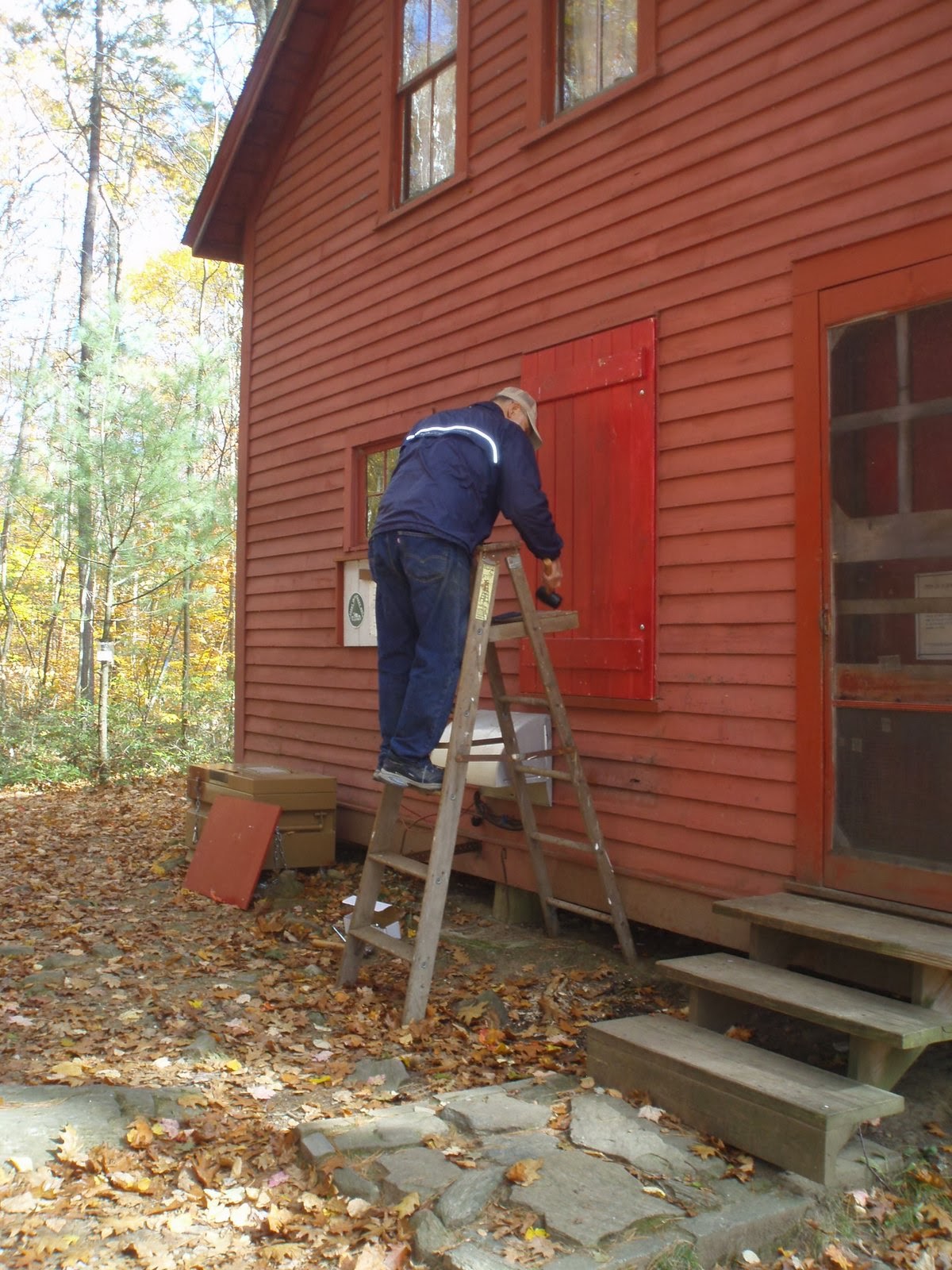
What does this entail?  If you have owned or operated a vacation home of some sort, you pretty much already know.  We need to remove materials left over from the season's operations--especially things that will not survive freezing, or are attractive to mice and other small critters.  The second consideration is (regretfully) securing the building and equipment from vandalism or improper use.  For better or worse, the Cabin is pretty easily accessible by hunters, hikers and snowmobile riders over the winter.  In the "bad old days" people would break in (typically through windows), help themselves to firewood, leave a mess behind and not treat the surroundings with respect.  This has tapered off quite a bit as we've been steadily increasing the "difficulty factor" for people breaking in over the past several years.   

Pete bolts on a shutter
All buttoned up
New shutters on front of bunkroom
Pete wades in to disconnect the floating dock.
Cabin closure is pretty much routine and consists of removing or securing in mouse-proof storage all the food and freezable liquids, storing the propane tanks away from the cabin, disconnecting the battery powered fire alarm system and installing wood shutters over the windows and doors.  

Pieces get stacked above the water line.
We also put the canoes into storage and finally, pull the dock out of the water.   This is a little easier late in the fall, as the pond is lowered over the winter to reduce the growth of weeds near the surface.  Still, it requires a bit of wading around the in chilly water, and at least four of us to get the heavy pieces above the water line.


While things are packed away, and the interior of the cabin is inaccessible,  the area is always open to visitors.  Tent platforms, privies, bear boxes and cooking areas are still available and ready for use--just like other overnight sites on the A.T.


 AT Committee members make regular winter time visits to check on conditions and perform ongoing minor maintenance.

Resting up for next year
About that "shutdown".  If the A.T. is managed by volunteers, what difference does it make if the government is in business or not?  National Parks are closed because there is no staff to operate them.  But the NPS APPA (Appalachian Trail Park Office) staff operates the AT indirectly with volunteers through ATC's 31 Trail Clubs.  The answer lies in some of the legislation regarding how Congress funds Federal agencies like the Park Service.  Seeking more information, I corresponded with Bob Proudman, ATC's Director of Conservation Operations. He said that it is our US government's legal interpretation of what constitutes closure under various national laws, principally the Anti-Deficiency Act of 1870, that prohibits volunteering.  As currently interpreted, this law stipulates that the government will not expend funds absent an appropriation from Congress or a resolution by Congress continuing a past appropriation (known as a "CR" or Continuing Resolution)

‘The Antideficiency Act prohibits federal agencies from obligating or expending federal funds in advance or in excess of an appropriation, apportionment, or certain administrative subdivisions of those funds. 31 U.S.C. §§ 1341, 1517(a). The act also prohibits agencies from accepting voluntary services. 31 U.S.C. §§ 1342." [Emphasis added].
It seems this is to prevent an agency from thwarting the intent of Congressional control by enlisting volunteers to do the work when Congress wishes the work not to take place.

While the footpath itself is pretty much impossible to close (except in more formally managed National Parks like Shenandoah or Smoky Mountains), facilities such as Upper Goose Pond Cabin (which is owned by the Park Service) are closed--even if staffed by volunteers.

So, there you have it.


Posted by Picasa

Monday, September 30, 2013

Another Day, Another Privy

September 28, 2013

They say whenever you get two or more AT volunteers together, the talk inevitably turns to S**t.   Managing human waste is an important part of what we do as trail managers.  Elsewhere in this blog, I've discussed why we just don't want people to camp anywhere they'd like.  The consequence of this is that when we concentrate use in a few locations (to preserve the rest of the Trail from impacts), we concentrate everything people do--from cooking to sleeping.  And people's byproducts are concentrated too.  

In some places on the AT (I'll refrain mention any specific places, but the state begins with a "T"), trail visitors are asked to "disperse" their waste and bury it in "catholes" about 6" below the ground's surface.  This works well for quick decomposition of the waste, but in an area around a shelter or campground, the available real estate for this activity is quickly used up--and not all hikers are skilled in making their deposits.  Add to this the intense traffic the A.T. generates and pretty soon the whole area around the shelter smells like an outhouse (well, it actually IS the outhouse).

The solution then, is to concentrate the deposition of waste in a place that does not impact the water supply, nor unduly degrade the hiking experience with odors and insects.  At most A.T. overnight sites in Mass (and now, elsewhere in New England) we have chosen to use "mouldering" type privies, where the waste is contained above ground and decomposed relatively quickly by aerobic bacteria and other critters.  At some overnight sites, where there is lower use, more room, and soils are easier to dig, we may choose to retain the traditional "Pit Privy".  Essentially a hole in the ground over which rests a toilet seat (and usually an small building to protect the user from weather and offer some privacy).

There are two problems with this: 1) The hole fills up. 2) The stuff does not decompose.  Burying waste in the ground slows decomposition, as oxygen-using organisms aren't present throughout the mass of waste.  Anaerobic critters take much longer to do their thing.  Old privy pits may remain essentially unchanged for years.

OK, enough talk.  In Mass, of 14 overnight sites we have three with pit privies.  About every 3-5 years, another pit needs to be dug and the old one covered with dirt.  This week it was Shaker Campsite.  Last dug in July of 2009, it was full pretty much to the top.

Step 1:  Pick spot for new hole.  This should be close to the current one, but not on top of an old hole or too far away (privies are heavy).  

Step 2: Dig the new hole.  We tipped the outhouse onto it's back so we could re-caulk the area where the vent pipe comes through the roof, and so some dirt from the new hole can be used to cap the old one.


Steve starts the digging

Don's turn to dig


Step 3: Keep digging.  The deeper the hole, the longer it will last.  Every shovel full of dirt we take out of the hole is 2-3 more deposits the hole will hold.  Eventually, the hole becomes so deep that the dirt can't be lifted out--about 31/2 feet deep is pretty much the limit.  The outhouse must completely cover the hole, so the hole measures about 3ft x 3ft.  The outhouse is 4ft x 4ft.
Steve is just about there

Not quite to China, but here's another 4 years of capacity


Don finishes up the caulking on the vent pipe.
Step 4: Move the outhouse.  No pictures here as all three of us were involved.  Important considerations: 1) Don't step into the old hole. 2) Don't step into the new hole.  Pile rocks on top of the cap of the recently covered hole to alert the next crew that this is not the place to dig a new one.


Friday, September 20, 2013

Nopel Patio Hardening

 September 14, 2013

Several of our shelters have a raised platform (or "patio") under the front overhang because of the slope of the ground where the shelter has been sited.  Picnic tables are placed under the overhang, not only for hiker's convenience, but to deter fires from being built directly in front of the shelter--so this patio needs to be reasonably level, pitched slightly for drainage.

Rock walls, or occasionally, wooden cribs are constructed, then filled with mineral soil taken from nearby borrow pits.  Because the patio is somewhat protected from the weather, the mineral soil never gets very wet and can be easily tracked into the shelter by hikers--especially when their boots are already wet.  Locations with sandy subsoils are particularly prone to this problem.  Earlier, we addressed the same issue at Wilcox South shelter  This post goes into a little more detail.

To remedy this, after the original patio has been used for a couple of years, we consolidate the mineral soil by mixing in cement and spread the mixture evenly over the surface and water it lightly.  The chemical reaction in the cement helps bond the dirt together creating a more durable surface.  Because the top coat has little structural strength, the soil underneath must be well-compacted. 

It starts with dirt.  Don harvests from the borrow pit.


3 parts mineral soil to one part cement.  Jim mixes small batches of the dry ingredients    


Dry mix is spread over well-compacted patio surface


Low spots are filled and lightly tamped with a rake


Jim and Steve use a screed board to make a smooth, flat surface


Surface is lightly watered


It sits for about a day while the mixture sets and dries.

Thursday, September 19, 2013

A Death on the Trail

Consider this an Op-Ed piece, these ramblings do not necessarily reflect the opinions of the Mass AT Committee, AMC, ATC or any of our Agency partners.


We had a hiker fall to his death on a side trail (which our Club maintains) to the AT this summer and there have been other fatalities elsewhere on the Trail this year that can be attributed to it’s physical challenges.  It brought to my mind that what we do is not without risk.  Our local story (in brief) occurred when a two brothers decided to hike down from Race Brook Falls campsite to “go check out the falls”.  They followed the blue-blazed trail down towards the road, and at some point (most likely where the trail turns left, away from the stream) went off-trail, past a line of large boulders and a double blaze placed to direct hikers to the left, and found themselves 50 yards later at the top of the waterfall.  From here, we as trail volunteers do not know what specifically happened next--we only know that one of the hikers fell down to the bottom of the upper waterfall.  Other hikers and local rescue personnel came to the scene, but were not able to save the man’s life.

So, this presents us a moment to think about some things:  As volunteer stewards we engage in many different aspects of trail management.  As well as physical maintenance of the trail, we write and edit the text in ATC’s guidebook, edit official maps, create and install trail signage, build bridges and construct shelters and privies at overnight sites.  What we can’t do of course, is get inside the head of trail visitors--we can only supply as much external information as we can--while keeping the hiking experience as “wild” as it can be.  As our AT Management Plan puts it:
“[Trail facilities]..should be constructed when appropriate to protect the resource or provide a minimum level of public safety. Design and construction of these facilities should reflect an awareness of, and harmony with, the Trail’s primitive qualities."

Just what is our personal risk in “providing a minimum level of public safety?”  A.T. volunteers are protected from Tort by the Volunteers in Parks program run by the NPS.  Club volunteers are considered “government employees”, and as such can’t be sued by hikers for injury, inconvenience, lost time, etc, as long as they are working within their job descriptions (part of which is reflected in the Management Plan quoted above).  

While we are protected--it does not remove our responsibility to do things the right way--follow design standards and maintain the physical condition of the trail as required by ATC.  We do all those things (and do them well), and still a hiker dies of his injuries.   Should/Could we do more?  Would railings or fences built to keep hikers on the trail or away from cliffs be in harmony with the Trail experience?  Should we build ATV-accessible “rescue routes” from nearby roads to the A.T., put mile markers on the blazes, and clear helicopter access openings in areas where there are higher numbers of hiker injuries and/or rescues?  We get these requests from local responders often when there is an incident on the Trail, but so far have not been required to provide them as they are not part of the standard we are required to follow.  

A hiker takes on a level of personal risk by choosing to hike the Trail--but I think, sadly, they are not always aware of that assumption.  Ultimately, they are responsible for their own actions.   There are going to be slippery rocks, muddy trail, unsigned road crossings or trail intersections, unprotected cliffs, even a scarcity of blazes.   When a hiker steps out of the parking lot and onto the AT she immediately enters a world where the “golden hour” that EMT’s value so much (the time between injury and the hospital) does not exist.  For some of us, that is part of the appeal of the Trail--the breaking of bonds between the protective shell of the “real” world and the freedom of the trail world.  I believe we should continue to avoid pressure to make the A.T. a “walk in the park”, to diminish the sense of remoteness and distance from the built world.   But, are we really ready for the consequences?  I think we did everything right regarding the physical condition and management actions on the Race Brook Falls Trail,  but I am thankful that it was not my son laying at the bottom of Race Brook Falls.

Wednesday, August 28, 2013

A New Roof for North Wilcox Privy

Working on privies  is never a pleasurable project, but they do need maintenance and care from time to time, so.......early this week our small crew headed to North Wilcox to replace the roof.  The roof on this privy had several holes in it and was generally in poor shape.  Also, the roof panels used barely covered the roof resulting in rotted fascia boards at the roof edges. 

We decided to nail short 2X4's to the front and back of the privy so we could tip it over on it's side making access to the roof easy. 

 
After removing the old roof, which took all of about 5 minutes, we built an extended roof structure from 2X4's to make the roof slightly larger affording more protection to the sides of the privy.  After nailing on the new fascia boards it was time to cut the hole in the first new roof panel to go around the privy vent.


Above Don screws the first panel down after much fiddling with the hole for the vent.  These fiberglass roof panels are not easy to cut but we finally made a satisfactory job of it and gooped up the join where the vent passes through the roof panel.  The rest of the roof panels went on easily with a minor problem to deal with.  We did not buy enough of the wood closure strips which are laid under the paneling to match up the corrugated underside of the panels with the flat 2X4 roof framing.  We solved this problem by leaving the bottom left side of the new roof unsecured.  It will be a quick job to return with the necessary closure strip and a screw gun finishing the job. 
 
 
With Silvia starting the painting we finished the roof job before tipping the privy back upright.
 
 
Here you see the nearly finished job which was shortly done and open for business.  It was a full days work so we packed up our tools and the old roofing and headed back to our vehicles.  The day held one last surprise.  We noticed a rather friendly hawk hanging out where the AT crosses Beartown Mtn road on our way into the project in the morning.  He (she?) was waiting for us on our return and even let me get a picture:


And so ended another great day of fun in the woods!  Checkout our Project Schedule https://docs.google.com/spreadsheet/ccc?key=0AvNh0IsoVlxpdHkyWG1iUmpuZV9uSGw5TU53d0xWYlE&usp=sharing for upcoming events and join us if you'd like.